https://lostcoastoutpost.com/nature/8448

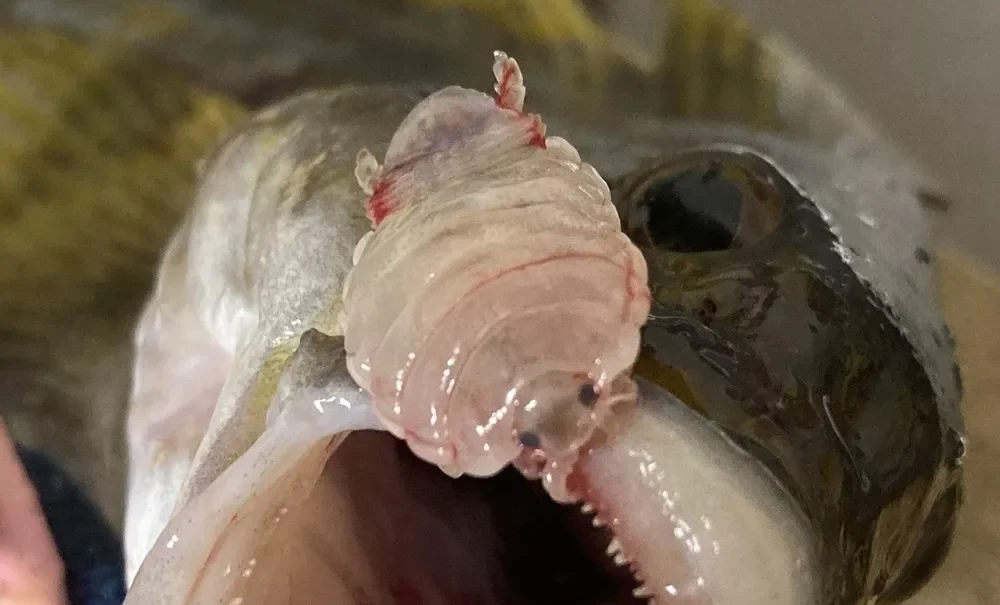
Cymothoa exigua, or better known as the tongue-eating louse, is a parasitic isopod found in both the Atlantic and Pacific Oceans [3]. Contrary to its common name, the isopod itself doesn’t conventionally eat the tongue of its host… instead, it feeds on the blood within the tongue’s blood vessels [5]. As the tongue atrophies and withers, the isopod takes its place [2],[7].
C. exigua belongs to a large family, Cymothoidae [1],[4]. Of the many members, most are site-specific and obligate ectoparasites [5]; Ceratothoa oestroides is another species within the family that also prefers the tongue [7].
To give you an idea of where these animals lie in relation to others, below is an outline of C. exigua’s taxonomic hierarchy [1],[2]. These organisms are arthropods and undergo several molts in their development [5].

Classifications:
- Kingdom: Animalia
- Phylum: Arthropoda
- Clade: Pancrustacea
- Class: Malacostraca
- Order: Isopoda
- Family: Cymothoidae
- Genus: Cymothoa
- Species: Cymothoa exigua
Common hosts include members of Perciformes and Atheriniformes: perches, snappers, drums, grunts, and silversides [1],[2]. Commercially and recreationally important species like the Pacific red snapper (Lutjanus peru) and the Colorado snapper (Lutjanus colorado) are largely affected [2],[3]. Interestingly enough, fishermen have reported that jellyfish, sharks, cephalopods, and other animals have been infected with this species (or other members of Cymothoidae) [7].
Surprisingly, the hosts can live a “somewhat” normal life outside of their tongue atrophying [6]. Hosts are often infected as fingerlings, growing with C. exigua inside [5],[6]. There is data indicating that growth is stunted in hosts, leading to smaller catch sizes [6]. Data also indicate reproductive difficulties in some host species [7].
C. exigua can live for three years within the host, but struggles without them [3],[5]; research is sparse in terms of what actually happens when the host dies [7].

C. exigua are protandrous hermaphrodites, born with male reproductive organs and later developing female reproductive organs [1],[2]. The initial stages after hatching are called pulli, divided into a larval and juvenile form: Pullus I & Pullus II [5], [7].
Pullus II is also referred to as the first mancae stage [6]. The juvenile manca will find its host, entering through the gills; it initially resides here [5]. The manca matures as a male until a second manca enters the gills; this “triggers” the first male to develop female reproductive organs [7]. Harboring female reproductive organs, C. exigua migrates to the host’s tongue [1]. The strongest (or only) male fertilizes the female’s brood, before or after the migration [6]. Each brood can contain up to 400 eggs, contained within her marsupium [7]. Thereafter, any dominant and smaller males remain in the gills [2], [5]. Adult sizes range between 7-29 mm, with females being almost double the size of males [2],[3].

- Females: 8-29 mm in length; 4-14 mm in width [2],[3].
- Males: 7.5-15 mm in length; 3-7 mm in width [2],[3].
It should be known that there is limited reproductive data on this species, as well as other limitations in data [5],[7].
There is difficulty in maintaining these organisms in a lab setting, as well as in making efforts to survey for them in the wild [7].
Information & Image References
[1] “Absurd Creature of the Week: This Parasite Eats a Fish’s Tongue — and Takes Its Place.” Wired, www.wired.com/2013/11/absurd-creature-of-the-week-the-parasite-that-eats-and-replaces-a-fishs-tongue/.
[2] “Cymothoa Exigua.” Wikipedia, 23 Oct. 2020, en.wikipedia.org/wiki/Cymothoa_exigua.
[3] Grano-Maldonado, Mayra Ixchel, et al. “New Host Records of Parasitic Isopods of Tropical Eastern Pacific Marine Fishes, with Remarks on the Taxonomy and Distribution of the Species.” Nauplius, vol. 33, 1 Jan. 2025, www.scielo.br/j/nau/a/GKF3znJTyDPndkNszGt3CNd/?format=html&lang=en, https://doi.org/10.1590/2358-2936e20250555.
[4] “HUMBOLDT LIFE: Meet Cymothoa Exigua, the Tongue-Eating Louse!” Lost Coast Outpost, 2026, lostcoastoutpost.com/nature/8448/. Accessed 24 May 2026.
[5] Jones, Conor M., et al. “Natatory-Stage Cymothoid Isopods: Description, Molecular Identification and Evolution of Attachment.” International Journal for Parasitology, vol. 38, no. 3-4, Mar. 2008, pp. 477–491, https://doi.org/10.1016/j.ijpara.2007.07.013. Accessed 17 Sept. 2021.
[6] Mladineo, Ivona, et al. “Host-Parasite Interaction between Parasitic Cymothoid Ceratothoa Oestroides and Its Host, Farmed European Sea Bass (Dicentrarchus Labrax).” Pathogens, vol. 9, no. 3, 20 Mar. 2020, p. 230, https://doi.org/10.3390/pathogens9030230.
[7] Smit, Nico J., et al. “Global Diversity of Fish Parasitic Isopod Crustaceans of the Family Cymothoidae.” International Journal for Parasitology: Parasites and Wildlife, vol. 3, no. 2, Aug. 2014, pp. 188–197, https://doi.org/10.1016/j.ijppaw.2014.03.004.