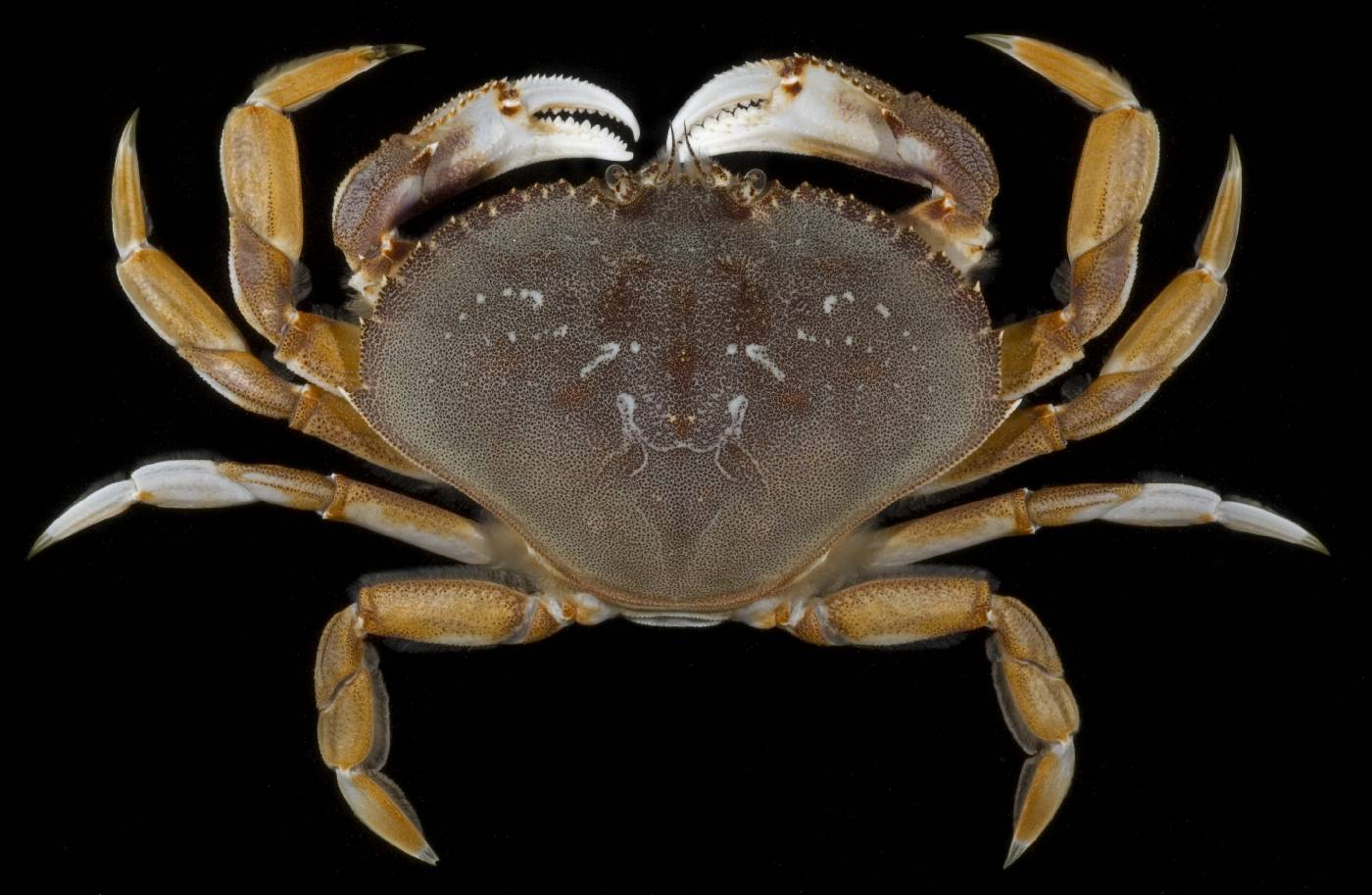
Dorsal view: Dungeness crab (Metacarcinus magister). https://invertebase.org/stri/taxa/index.php?tid=60162&clid=0&pid=0&taxauthid=1
Classifying Brachyura
Brachyura, or the true crabs, are an infraorder of decapod crustaceans [54]. They have several defining characteristics, such as having four pairs of walking legs and a single pair of chelae (claws), a reduced pleon (also called an apron), and a fused carapace that gives them that stereotypical crab look [5],[40]. The pleon is one of the more notable and distinguishable characteristics, being that the term Brachyura is actually Greek: it directly translates to “short-tailed” [24].

The reduced pleon is used to differentiate between males and females of this infraorder [14]. The diagram on the left shows the significantly more tapered pleon of the male [28]. The right shows the widened and rounded pleon of the female.
As mentioned above, these are decapod crustaceans. Their classifications are the following [41]:
- Kingdom: Animalia
- Phylum: Arthropoda
- Clade (subgroup): Pancrustacea
- Class: Malacastroca
- Order: Decapoda
- Clade (subgroup): Reptantia
- Infraorder: Brachyura

The earliest “crabs” appear about 200 million years ago, during the Jurassic Period [43],[50]. There are well-understood trends in their morphology: an overall shortening of the body, including reductions in the abdomen and pleon [58]. Nonetheless, the extremes of these trends are seen within the “untrue crabs”: infraorder Anomura.
This figure displays a fossil and reconstruction of Eocarcinus praecursor, via Gerhard Scholtz’s research [57]. Within the 2020 research article, the author notes that this species is the earliest “stem-group fossil”, or closest relative to an extant group.
During the Cretaceous, asymmetrical claws started to become a significant feature, expanding across many groups of Brachyurans [50]. Since then, the infraorder has diversified; over 7,200 species comprise Brachyura [30],[58].
Life History I: Ecdysis
All arthropods undergo ecdysis, a physiological process that results in the organism shedding its outer cuticle [45]. It is hormone-mediated, particuarly by ecdysteroids [48]. These hormones are part of a group called polyhydroxylated ketosteroids, which have an influence on reproduction and development [53],[59]. The overall process has been organized under the Drach system [39]. Pierre Drach created the following organization in 1939, describing these morphological and physiological changes[39],[48]:
- Stage A: Postecdysis I
- Stage B: Postecdysis II
- Stage C: Intermolt
- Stage D: Proecdysis
- Stage E: Ecdysis
There are designated substages to each of the stages above, which are not covered here. To keep things moving forward, below are summaries of each stage.
Drach’s Steps
Stage A: the immediate post-molt period of the arthropod, where its cuticle is soft and susceptible to the elements around the animal [45]. It’s s also called early Metecdysis. In this stage, the arthropod is absorbing water into its tissues, which creates a hydrostatic pressure to stretch the new epicuticle outward [52]. The organism is permeable and cannot support its own weight [45].
Stage B: similar to Stage A, where calcification is starting to kick in [40],[45]. It is referred to as late Metecdysis. Here, the arthropod utilizes its calcium reserves and calcium ions from the water to build up the exocuticle (different from the epicuticle) [52]. The chelipeds and walking legs are hardened enough to use, with the carapace remaining flexible [52]. Calcification continues for all appendages and the carapace, while the endocuticle begins to secrete [45],[52].
Stage C: where calcification continues until the layers reach peak structural rigidity; the organism regains metabolic and hormonal stability, with no more tissue synthesis [45]. The carapace, gastric mill, and other mouthparts are fully calcified [45],[52]. A last membranous layer is secreted between the epidermal and endocuticle [52]. The arthropod feeds to build muscle mass, replacing the internal water volume contained in Stage A [53].
Stage D: entering “pre-molt” and preparing by producing more ecdysteroids [45]. The current exoskeleton is slightly broken down in the process, and excess calcium is retained by the organism [52]. There is a gap (which widens through this stage) between the actual exoskeleton and the tissue beneath it [52]. Apolysis soon happens- the complete separation of living epidermal cells detaching from the membranous layer beneath [45],[52]. In that gap is where the new epicuticle forms [52]. As the old exoskeleton softens, chitinases and proteases are secreted in the reserved space [53]. Simultaneously, the new epicuticle is forming [45].
- There’s no more feeding [44]; the stomach lining is molting, too! The brachyuran seeks a safe place to lie, such as a dark crevice.
- Intense demineralization occurs where the carapace meets the apron, also called the ecdysial suture lines [52].
Stage E: the actual shedding event [45]. This is the most vulnerable time for the animal. The brachyuran swallows water into the gut, thereby increasing blood volume [52]. In turn, this creates hydrostatic pressure that pushes against the old, broken-down epicuticle [52]. It “ruptures” at the ecdysial suture lines [52]. Using muscular contractions, the crab slowly exits through the opening of the ecydisal suture lines [45],[52]. As soon as all organs and appendages are outside of the shed, Stage A occurs.
This source provides insight into ecdysis for horseshoe crabs, which are NOT brachyurans but have a similar molting process. https://www.biorxiv.org/content/10.64898/2026.02.27.708456v1.full
Life History II: Reproduction
Reproduction in Brachyurans occurs internally, typically after females shed their exoskeleton [59]. Post-ecdysis, the new cuticle is soft, allowing access to open gonopores: the male inserts his spermatophores into them, permitting the sperm to reach her spermathecae [40]. The male will hold onto the female until her exoskeleton hardens [54]. The female can store sperm for years, possessing the ability to fertilize multiple batches of eggs over time [31].
- Here is an additional FWC source if you’re interested: https://myfwc.com/research/saltwater/crustaceans/blue-crabs/life-cycle/
Brooding the eggs is the next step, where the female attaches them to the pleon (or apron). This “look” has inspired the name “The Sponge Stage” when referring to brooding [31]. There are several advantages to keeping the eggs here, such as protection, ease of grooming, and the ability to aerate the eggs with her pleopods (swimmerets) [38].

Within females, the number of eggs she produces is often related to the width of her carapace and the number of eggs she carries within her pleon [46]. There is evidence for tradeoffs occurring between egg number and egg size, which are all heavily impacted by the conditions the mother endures [38].
Life History III: Life Stages
Embryonic development continues, tucked into the female’s pleon [60]. This development continues for a varied amount of time, depending on species, water temperature, and timing of the lunar cycle [12]. Eggs are released at nocturnal high tides, notably during new or full moons [38]. Spring tides occur under these conditions and are able to carry eggs out to the pelagic.
Brachyurans, like many other arthropods, go through indirect development. Indirect development describes organisms that hatch and do not morphologically or behaviorally resemble their adult forms (i.e., through diet, locomotion, habitat, etc.). For many brachyurans, eggs that are released become protozoea larvae, which quickly molt into zoea larvae [37]. Below is an image of zoea and its “shrimp-like appearance” [37]. Their swimming capabilities stem from the cephalothorax, which forms the mandibles and antennae once the larvae become adults [60]. Zoea are both filter-feeders and predators, feeding on smaller plankton [60].

Zoeae is the first life stage of many crustaceans, expanding far beyond Brachyura [56]. It is free-swimming, planktonic, and predatorial [46]. You can see the rounded body, long segmented tail, and spiny appendages around the body [47]. These stages have multiple parts, characterized by molts; each stage is named as Zoea I, Zoea II, Zoea III… The period between each molt period is called an instar, where brachyurans can have anywhere from two to eight zoeal instars [46]. Though these may be days apart, every molt shows clearer tagmata and an increase in size: a cephalothorax and an abdomen become apparent [60].
During the final molt of the zoeae stage, the organism metamorphoses into a new larval stage: the megalops stage [60]. Some species skip this stage entirely and immediately enter the first juvenile instar [61]. Here, brachyurans finally begin to resemble themselves.
Megalops are dorsoventrally flattened with a broad carapace and have a tuckable abdomen that fits underneath the cephalothorax; this allows the larvae to sit atop substrate [42]. The abdomen also functions posteriorly (pictured below), and aids the pleopods in swimming action [42].

By now, megalops display full chelipeds and long setae upon their pleopods [47],[51]. They are fully capable of directional swimming, particuarly against currents [60]. Megalops are larger than most plankton, preventing them from occupying the same habitat as before [49]. Though they aren’t settled on the substrate just yet, they are influenced strongly by the benthic boundary layer immediately above the substrate [52]. There is only one megalops instar, where they finally settle on the substrate before metamorphosing into the first juvenile instar [42].
Most species remain benthic as juveniles, like adults. Though these stages are similar, juveniles possess differing appendage proportions and setae arrangements [55]. This stage is marked by growth, stemming towards whether the brachyuran will be an indeterminate or determinate grower. As sexual maturity approaches, the juveniles are placed into these two categories, which are a tell on whether they will enter anecdysis and put all energy into reproduction, or invest their energy into both growth and reproduction. The majority of brachyurans encompass the second group. Indeterminate juveniles have significantly more instars, whereas determinate juveniles have fewer instars.

The beginning of the juvenile stage is marked by several instars, sometimes all occurring within weeks. After most molts, an appendage is added. “The puberty molt” marks the end of the juvenile stage; the proportions of all appendages are allometric, gonads are present and functional, and growth rate ceases [52]. The post-puberty stage of this molt can turn into a terminal molt, marking the end of growth for determinate growers. For indeterminate growers, reproduction and molting can occur in a cyclic pattern.

The adult stage completes the life cycle of Brachyura. The shape and behavior of these animals are typically what we think of when “crabs” are mentioned. Though brachyurans are solitary in nature, they are incredibly active. Diets are mostly omnivorous, but some prefer to feed exclusively on algae. They engage in durophagy- the ability to feed on hard-shelled organisms like clams and mussels.
Fun fact: The Florida Stone Crab (Menippe mercenaria) has claws that can exert a crushing force of 14,000-43,200 PSI (4x stronger than the bite force of an alligator). See it to the left.
Diversity in Brachyura
Though I referred to marine brachyurans within this post, there are roughly 1300 freshwater species and 300 terrestrial species. Marine species encompass the vast majority of this group, extending to over 5,800 species. Brachyurans are found all over the world, in a wide variety of environments: mangroves, cold seeps, mudflats, reefs, and hydrothermal vents. Here are a few examples that exemplify Brachyuran diversity, and some of my favorites…


Gecarcoidea natalis, the Christmas Island Red Crab [13],[19]. They are known for their annual mass migrations, covering roads in a carpet of crabs! Movements occur from the beginning of the wet season (October to November) towards the nearby coasts [13]. This occurs over the course of a week, during which roads are blocked to take precautions for the migration [13].


Diversity & Image References
[1] “Achaeus Japonicus, Orang-Utan Crab.” Archive.org, 2026, web.archive.org/web/20111119085755/www.seadb.net/en_Orang-utan-crab-Achaeus-japonicus_54.htm. Accessed 29 May 2026.
[2] Antunes, Mariana, et al. “Morphological Analysis of the Female Reproductive System of Stenorhynchus Seticornis (Brachyura: Inachoididae) and Comparisons with Other Majoidea.” Invertebrate Biology, vol. 135, no. 2, 8 Apr. 2016, pp. 75–86, https://doi.org/10.1111/ivb.12118. Accessed 25 Mar. 2025.
[3] Barr, Louis. Biology and Behavior of the Arrow Crab, Stenorhynchus Seticornis (Herbst), in Lameshur Bay, St. John, Virgin Islands. 1975.
[4] Block, Melissa. “Stenorhynchus Seticornis (Yellowline Arrow Crab).” Animal Diversity Web, 2001, animaldiversity.org/accounts/Stenorhynchus_seticornis/.
[5] “Brachyura.” Mr. Van’s Animal Collection, 2026, mrvansanimals.weebly.com/brachyura.html. Accessed 29 May 2026.
[6] “COPEPEDIA Summary for Ixa Inermis : T4005441 : Species.” Noaa.gov, 2020, www.st.nmfs.noaa.gov/copepedia/taxa/T4005441/. Accessed 29 May 2026.
[7] “CRAB – POM POM Lybia Tessellata – Aquatics Unlimited.” Aquatics Unlimited, 27 May 2026, aquaticsunlimited.com/product/02dcd191-aec2-11ea-f336-75360568ef18/. Accessed 29 May 2026.
[8] Crab Database, 2016 (www.crabdatabase.info. “Crab Database · Crabs · Genus Ixa.” Crabdatabase.info, 2026, www.crabdatabase.info/en/crabs/brachyura/eubrachyura/heterotremata/leucosioidea/leucosiidae/ixa-5865. Accessed 29 May 2026.
[9] Davie, P.J.F., and P.A. Turner. “A NEW RECORD and NEW SPECIES of PARTHENOPE from NORTHERN AUSTRALIA (CRUSTАСЕА: ВRACHYURA: PARTHENOPIDAE) P. J. F. Davie and P. A. Turner.” RAFFLES BULLETIN of ZOOLOGY , vol. 42, no. 4, 1994, pp. 975–981, https://doi.org/DOI%2010.5281/zenodo.4507026.
[10] Devarajan , K., and G. GIRIJAVALLABHAN. ON the OCCURRENCE of IXA INERMIS LEACH in INDIAN WATERS with TAXONOMIC NOTES on the SPECIES.
[11] “File:Orangutan Crab – Achaeus Japonicus.jpg – Wikimedia Commons.” Wikimedia.org, 4 Feb. 2008, commons.wikimedia.org/wiki/File:Orangutan_Crab_-_Achaeus_japonicus.jpg. Accessed 29 May 2026.
[12] Giangreco, Leigh. “TIDES: The Spectacular Life Cycle of a Crab.” The Daily Times, www.delmarvanow.com/story/news/2014/03/08/the-spectacular-life-cycle-of-a-crab/6204021/.
[13] Griffiths, Megan E, et al. “Dry Season Distribution of Land Crabs, Gecarcinus Quadratus (Crustacea: Gecarcinidae), in Corcovado National Park, Costa Rica.” Revista de Biología Tropical, vol. 55, no. 1, 2025, pp. 219–224, www.scielo.sa.cr/scielo.php?script=sci_arttext&pid=S0034-77442007000100023.
[14] “How to Determine Sex of Regulated Invertebrates.” Division of Aquatic Resources, 9 May 2014, dlnr.hawaii.gov/dar/fishing/fishing-regulations/marine-invertebrates/how-to-determine-sex-of-regulated-invertebrates/.
[15] IXA INERMIS LEACH (CRUSTACEA, DECAPODA, BRACHYURA) a NEW RECORD from INDIAN WATERS.
[16] Litulo, Carlos. “Reproductive Biology of the Hairy Crab Pilumnus Vespertilio (Brachyura: Pilumnidae) in the East African Region.” Journal of the Marine Biological Association of the United Kingdom, vol. 85, no. 4, 27 June 2005, pp. 877–881, https://doi.org/10.1017/s0025315405011835. Accessed 29 May 2026.
[17] “Majidae.” Google Books, 2026, books.google.com/books?hl=en&lr=&id=kyMVAAAAIAAJ&oi=fnd&pg=PA1&dq=Achaeus+japonicus&ots=XdQUwg-iKh&sig=3u_O0D5yRvrBnVHck5eNGw5XsMw#v=onepage&q=Achaeus%20japonicus&f=false. Accessed 29 May 2026.
[18] “Malapascua Whip Coral Shirmp and Xeno Crab – Evolution Diving Resort Malapascua.” Evolution Diving Resort Malapascua, 27 Sept. 2014, evolution.com.ph/crazy-crustaceans-malapascua/malapascua-whip-coral-shirmp-and-xeno-crab/. Accessed 29 May 2026.
[19] Morris, Steve. “The Ecophysiology of Air-Breathing in Crabs with Special Reference to Gecarcoidea Natalis.” Comparative Biochemistry and Physiology Part B: Biochemistry and Molecular Biology, vol. 131, no. 4, Apr. 2002, pp. 559–570, https://doi.org/10.1016/s1096-4959(02)00011-8. Accessed 14 May 2020.
[20] Peter, et al. “TAXONOMIC NOTES on THREE INDO-WEST PACIFIC SPECIES of CALAPPA (DECAPODA: BRACHYURA: CALAPPIDAE).” THE RAFFLES BULLETIN of ZOOLOGY, vol. 47, no. 2, 1999, pp. 607–616, lkcnhm.nus.edu.sg/wp-content/uploads/sites/11/app/uploads/2017/04/47rbz607-616.pdf. Accessed 29 May 2026.
[21] “Pilumnus Vespertilio (Pilumnus Vespertilio) | U.S. Fish & Wildlife Service.” FWS.gov, 2026, www.fws.gov/species/pilumnus-vespertilio-pilumnus-vespertilio. Accessed 29 May 2026.
[22] “Pilumnus Vespertilio – Safari Afrika.” Safari-Afrika.de, 2026, www.safari-afrika.de/tierwelt/krebstiere/pilumnus-vespertilio/. Accessed 29 May 2026.
[23] Porter, Mike. “True Crabs.” Bugs with Mike, Mike Porter, 5 Dec. 2025, bugswithmike.com/guide/arthropoda/crustacea/malacostraca/eucarida/decapoda/brachyura.
[24] “Subphylum Crustacea Order Decapoda Infraorder Brachyura Key: True Crabs.” Wallawalla.edu, 2026, inverts.wallawalla.edu/Arthropoda/Crustacea/Malacostraca/Eumalacostraca/Eucarida/Decapoda/Brachyura/Decapoda_Brachyura_Key.html. Accessed 29 May 2026.
[25] Takeda, Masatsune, et al. “A New Species of the Family Bythograeidae (Crustacea, Decapoda, Brachyura) from the Hydrothermal Vents along Volcanic Front of the Philippine Sea Plate.” BULLETIN of the NATIONAL SCIENCE MUSEUM Series a (Zoology), vol. 26, no. 4, 2000, research.nhm.org/pdfs/12145/12145-001.pdf. Accessed 29 May 2026.
[26] The, et al. “EXTERNAL FACTORS DETERMINING the REPRODUCTIVE PERIODICITY in a TROPICAL POPULATION of the HAIRY CRAB PILUMNUS VESPERTILIO (DECAPODA: BRACHYURA: PILUMNIDAE).” THE RAFFLES BULLETIN of ZOOLOGY, vol. 53, no. 1, 2005, pp. 115–118, www.science.nus.edu.sg/wp-content/uploads/sites/11/2005/09/53rbz115-118.pdf. Accessed 29 May 2026.
[27] “The Intimate Relationship between Boxer Crabs and Sea Anemones: What Is Known and What Is Not.” Typeset.io, 16 Nov. 2022, pp. 495–531, typeset.io/papers/the-intimate-relationship-between-boxer-crabs-and-sea-23rtjeyk, https://doi.org/10.1201/9781003288602-10. Accessed 8 Feb. 2024.
[28] Treatise on Zoology – Anatomy, Taxonomy, Biology. The Crustacea, Volume 9 Part c (2 Vols). Brill, 2015.
[29] “Tuberculatus Xeno Crab (Xenocarcinus Tuberculatus) | Lembeh Resort.” Lembehresort.com, 2026, www.lembehresort.com/critter-log/critter/xenocarcinus-tuberculatus. Accessed 29 May 2026.
[30] Wikipedia Contributors. “Brachyura.” Wikipedia, Wikimedia Foundation, 12 Jan. 2026.
[31] “Xenocarcinus.” Wikipedia, Wikimedia Foundation, 1 Feb. 2026.
[32] Won Tack Yang. “Studies on the Western Atlantic Arrow Crab Genus Stenorhynchus (Decapoda Brachyura, Majidae) I. Larval Characters of Two Species and Comparison with Other Larvae of Inachinae 1).” Crustaceana, vol. 31, no. 2, 1976, pp. 157–177, https://doi.org/10.1163/156854076×00198. Accessed 29 May 2026.
[33] “World Register of Deep-Sea Species – Austinograea Yunohana Takeda, Hashimoto & Ohta, 2000.” Marinespecies.org, 2025, www.marinespecies.org/Deepsea/aphia.php?p=taxdetails&id=452025. Accessed 29 May 2026.
[34] “WoRMS – World Register of Marine Species – Brachyura.” Www.marinespecies.org, www.marinespecies.org/aphia.php?p=taxdetails&id=106673.
[35] “WoRMS – World Register of Marine Species – Xenocarcinus Tuberculatus White, 1847.” Marinespecies.org, 2026, marinespecies.org/aphia.php?p=taxdetails&id=208897. Accessed 29 May 2026.
[36] “Zebrida Adamsii.” Critter Republic Dive Center – Philippines Best SCUBA Destination., 7 Nov. 2024, critterrepublic.com/zebrida-adamsii/.
Life History & Fossil Information
[37] Cházaro-Olvera, Sergio. “Morphology of the Zoeae Larvae of Brachyura (Crustacea, Decapoda) in Veracruz, Southwestern Gulf of Mexico.” American Journal of Life Sciences, vol. 1, no. 5, 2013, p. 238, https://doi.org/10.11648/j.ajls.20130105.16. Accessed 23 Apr. 2025.
[38] Christy, John H. “Timing of Hatching and Release of Larvae by Brachyuran Crabs: Patterns, Adaptive Significance and Control.” Integrative and Comparative Biology, vol. 51, no. 1, 18 May 2011, pp. 62–72, https://doi.org/10.1093/icb/icr013. Accessed 28 Dec. 2021.
[39] Criel, J, and Hilde. “Molt Staging in Artemia Adapted to Drach’s System.” Journal of Morphology, vol. 199, no. 1, 1 Jan. 1989, pp. 41–52, https://doi.org/10.1002/jmor.1051990105. Accessed 30 May 2026.
[40] Davie, Peter J. F., et al. “ANATOMY and FUNCTIONAL MORPHOLOGY of BRACHYURA1).” Treatise on Zoology — Anatomy, Taxonomy, Biology. The Crustacea, vol. 9, Aug. 2015, pp. 11–163.
[41] Davie, Peter J.F., et al. “SYSTEMATICS and CLASSIFICATION of BRACHYURA1).” Treatise on Zoology — Anatomy, Taxonomy, Biology. The Crustacea, vol. 9, Aug. 2015, pp. 1049–1130.
[42] Epifanio, CE, et al. “Development and Behavior of Megalopa Larvae and Juveniles of the Hydrothermal Vent Crab Bythograea Thermydron.” Marine Ecology Progress Series, vol. 185, 1999, pp. 147–154, https://doi.org/10.3354/meps185147. Accessed 9 Dec. 2020.
[43] Feldmann, Rodney M., and Carrie E. Schweitzer. “Is Eocarcinus Withers, 1932, a Basal Brachyuran?” Journal of Crustacean Biology, vol. 30, no. 2, 1 May 2010, pp. 241–250, https://doi.org/10.1651/09-3230.1. Accessed 4 Dec. 2022.
[44] Figueiredo, Joana, et al. “Effect of Starvation during Late Megalopa Stage of Mithraculus Forceps (Brachyura: Majidae) on Larval Duration, Synchronism of Metamorphosis, Survival to Juvenile, and Newly Metamorphosed Juvenile Size.” Aquaculture, vol. 274, no. 1, Jan. 2008, pp. 175–180, https://doi.org/10.1016/j.aquaculture.2007.10.052. Accessed 5 May 2023.
[45] Guerao, Guillermo, et al. Characterization of Larval Moulting Cycles in Maja Brachydactyla (Brachyura, Majidae) Reared in the Laboratory. Vol. 302, no. 1-2, 1 Apr. 2010, pp. 106–111, https://doi.org/10.1016/j.aquaculture.2010.02.010. Accessed 22 May 2023.
[46] Hines, Anson H. “LARVAL PATTERNS in the LIFE HISTORIES of BRACHYURAN CRABS (CRUSTACEA, DECAPODA, BRACHYURA).” BULLETIN of MARINE SCIENCE, vol. 39, no. 2, 1986, pp. 444–466.
[47] Islam, Md. Sirajul, et al. “Larval Development of the Swimming Crab Charybdis Natator (Crustacea : Brachyura : Portunidae) Reared in the Laboratory.” Species Diversity, vol. 5, no. 4, 2000, pp. 329–349, https://doi.org/10.12782/specdiv.5.329. Accessed 28 Sept. 2020.
[48] Kim, Kenneth, et al. “Moult Cycle and Setal Development of the Atlantic Ditch Shrimp Palaemon Varians Leach, 1814 (Decapoda: Caridea: Palaemonidae).” Journal of Crustacean Biology, vol. 44, no. 4, 25 Nov. 2024, academic.oup.com/jcb/article/44/4/ruae075/7922268, https://doi.org/10.1093/jcbiol/ruae075. Accessed 23 Apr. 2025.
[49] Kim, Mi-Hyang, et al. “Description of the Megalopal Stage of Orithyia Sinica (Decapoda: Brachyura: Orithyiidae) Reared in the Laboratory.” Journal of Fisheries and Marine Sciences Education, vol. 26, no. 2, 30 Apr. 2014, pp. 437–443, https://doi.org/10.13000/jfmse.2014.26.2.437. Accessed 30 May 2026.
[50] Krobicki, Michał, and Michał Zatoń. “Middle and Late Jurassic Roots of Brachyuran Crabs: Palaeoenvironmental Distribution during Their Early Evolution.” Palaeogeography, Palaeoclimatology, Palaeoecology, vol. 263, no. 1-2, June 2008, pp. 30–43, https://doi.org/10.1016/j.palaeo.2008.01.025. Accessed 23 Nov. 2022.
[51] Martin, Joel W. Phylogenetic Significance of the Brachyuran Megalopa: Evidence from the Xanthidae. 1 Jan. 1988. Accessed 30 May 2026.
[52] Mclay, Colin. Moulting and Growth in Brachyura. Vol. 9, Treatise on Zoology- Anatomy, Taxonomy, Biology., 2015, pp. 245–316.
[53] Mykles, Donald L. “Ecdysteroid Metabolism in Crustaceans.” The Journal of Steroid Biochemistry and Molecular Biology, vol. 127, no. 3-5, Nov. 2011, pp. 196–203, https://doi.org/10.1016/j.jsbmb.2010.09.001. Accessed 12 Dec. 2022.
[54] Ng, Peter K. L. , et al. “Crustacea: Decapoda, Brachyura.” The Raffles Bulletin of Zoology, vol. 17, 31 Jan. 2008, pp. 1–286.
[55] Pohle, Gerhard, and Malcolm Telford. MORPHOLOGY and CLASSIFICATION of DECAPOD CRUSTACEAN LARVAL SETAE: A SCANNING ELECTRON MICROSCOPE STUDY of DISSODACTYLUS CRINITICHELIS MOREIRA, 1901 (BRACHYURA: PINNOTHERIDAE).
[56] Rice, A. L. “Crab Zoeal Morphology and Its Bearing on the Classification of the Brachyura.” The Transactions of the Zoological Society of London, vol. 35, no. 3, Apr. 1980, pp. 271–372, https://doi.org/10.1111/j.1096-3642.1980.tb00060.x. Accessed 5 Feb. 2022.
[57] Scholtz, Gerhard. “Eocarcinus Praecursor Withers, 1932 (Malacostraca, Decapoda, Meiura) Is a Stem Group Brachyuran.” Arthropod Structure & Development, vol. 59, 1 Nov. 2020, p. 100991, www.sciencedirect.com/science/article/pii/S1467803920301146?via%3Dihub, https://doi.org/10.1016/j.asd.2020.100991. Accessed 3 Dec. 2022.
[58] STEVCIC, ZDRAVKO. THE MAIN FEATURES of BRACHYURAN EVOLUTION . Vol. 20, 1971, pp. 331–340.
[59] T. Subramoniam. “Crustacean Ecdysteriods in Reproduction and Embryogenesis.” Comparative Biochemistry and Physiology Part C: Pharmacology, Toxicology and Endocrinology, vol. 125, no. 2, 1 Feb. 2000, pp. 135–156, https://doi.org/10.1016/s0742-8413(99)00098-5.
[60] Wear, R.G , and D.R. Fielder. The Marine Fauna of New Zealand: Larvae of the Brachyura (Crustacea, Decapoda)R. New Zealand Oceanographic Institute, 1981, pp. 1–90.
[61] Wear, Robert G. “Life‐History Studies on New Zealand Brachyura.” New Zealand Journal of Marine and Freshwater Research, vol. 1, no. 4, 1 Dec. 1967, pp. 482–535, https://doi.org/10.1080/00288330.1967.9515221. Accessed 3 Jan. 2026.